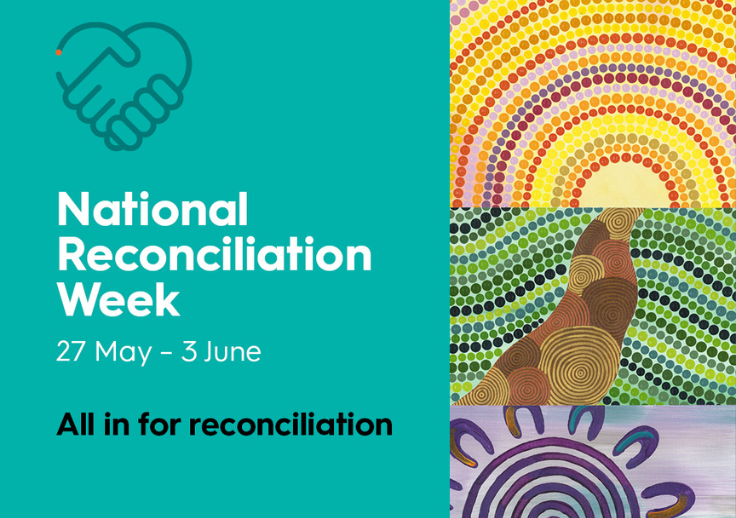
Held every year from 27 May to 3 June, it’s a time for all Australians to learn and explore how each of us can contribute to achieving reconciliation.
All In makes clear that reconciliation is not a spectator sport and that all of us must step away from the sidelines and take action to make change.
Reconciliation is an ongoing journey that reminds us that while generations of Australians have fought hard for meaningful change, we must continue to strive towards our goal of a just, equitable and reconciled Australia.
“National Reconciliation Week is an important time for us to reflect on our progress and renew our commitment. It encourages all of us to learn more about our shared history, recognise the contributions of First Nations peoples, and consider the role we each play in driving meaningful change” – Sarah Frost, APO Coordinator and proud Dja Dja Wurrung and Gadigal woman.
Aruma’s Reconciliation Action Plan (RAP)
Our First Nations Working Group are currently in the process of finalising the Reflect RAP. The second RAP, which is called the Innovate RAP is currently in development, aims to further the deliverables from the first RAP while building in more strategies that aim to increase outcomes and cultural safety for our First Nations participants, staff and community partners.
Sarah Frost, APO Coordinator and Proud Dja Dja Wurrung and Gadigal woman said: “As Aruma continues its reconciliation journey, moving into the next phase of our Reconciliation Action Plan is an important step forward for us as an organisation. It’s not just about what we commit to, it’s about how we embed reconciliation into our everyday work. This next phase represents a shift from building awareness to driving deeper impact.
“Reconciliation is everyone’s responsibility. At its heart, it’s about building trust, respect and understanding, and acknowledging the truths of Australia’s history. For Aruma, this aligns strongly with our values supporting inclusion, valuing diversity, and creating opportunities for people to thrive.
“Our RAP is more than a framework it’s a commitment to ongoing learning, accountability and action. As we move into this next phase, every one of us has a role to play in bringing it to life and helping create a more inclusive and respectful future,” she said.