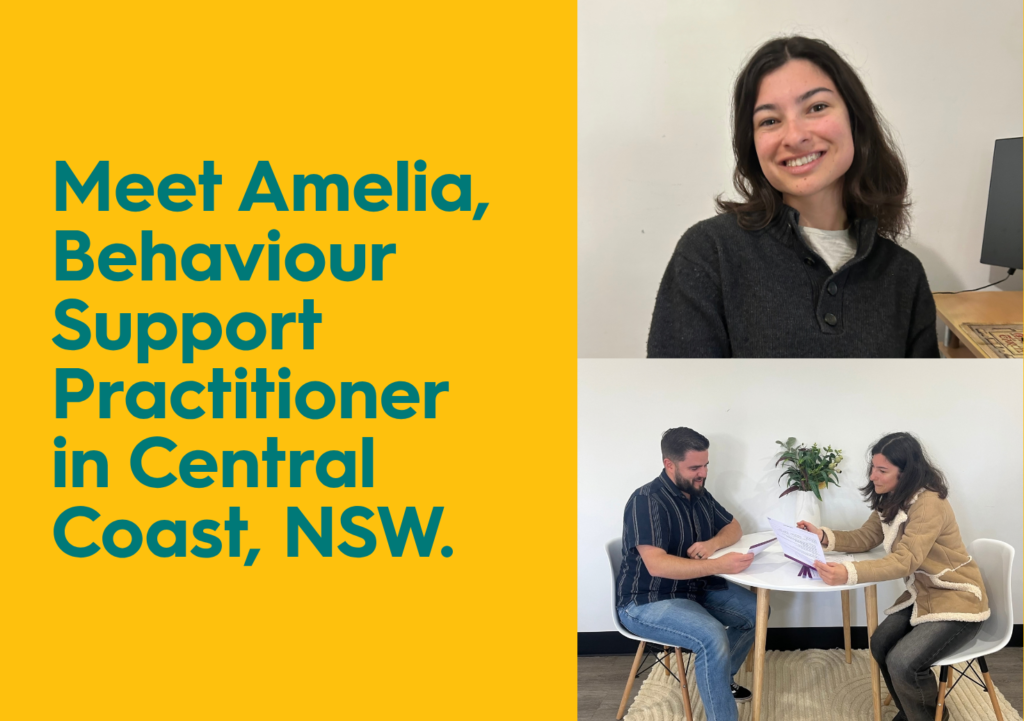
Amelia is part of our team operating on the Central Coast of New South Wales. The small but mighty team works alongside participants, families and their wider support network to understand why behaviours of concern happen and to build practical strategies that support positive change, together.
We sat down with Amelia to better understand her day-to-day, what she enjoys most and what she wishes you knew about positive behaviour support.
Tell us a little about your role?
I support both children and adults to reduce behaviours of concern and improve their overall quality of life.
A key part of my role is understanding what is happening beneath the surface and identifying the underlying reasons behind a person’s behaviours to improve a person’s overall quality of life.
Recently, a support coordinator pointed out that we are actually delivering ‘positive life plans’, because our goal is to help people build the skills, supports, and environments they need to achieve their goals, increase their independence, and participate in the things that are meaningful to them.
What made you want to become a Behaviour Support Practitioner?
My experience of working in the field as a support worker showed me how It can be incredibly difficult for families, carers, and support workers who witness these challenges every day and want to help but may not always know how.
I wanted to become a Behaviour Support Practitioner so I could support not only the participant, but also the people around them. By working together, we can better understand what is driving the behaviour, reduce distress, and create positive outcomes that improve quality of life for everyone involved.
What are the highlights of your role?
One of the biggest highlights of my role is spending time with participants and their support networks and seeing the positive changes they achieve over time.
I also recently attended a community outing with a participant and their support worker. You could clearly see the positive connection they had built with the participant. By the end of the visit, he started giggling, which quickly had both the support worker and me laughing as well. It was such a simple but powerful moment that highlighted the impact of quality support.
Can you give us a run-down of a day in your life as a Behaviour Support Practitioner?
No two days are ever the same in this role, and that’s one of the things I enjoy most about it. A typical day usually starts by checking and responding to emails that have come through overnight.
After that, I might spend time creating resources or preparing for participant visits. When working with children especially, engagement is so important, so having activities and resources ready beforehand makes a huge difference – I’ve learnt that anything Fortnite-related is usually the way to go!
By mid-morning, I will often have my first visit of the day. This might take place at a school, in a participant’s home, in the community, or alongside a support worker. Every participant has different goals and needs, which means every visit looks a little different. Each visit has different purpose too, it may be training staff, observing environments, speaking directly to the participant or their supports.
Following visits, I usually spend the afternoon completing reports, documenting progress, responding to emails, and developing behaviour support plans and then it’s home time.
Any frequently asked questions you would like to address?
There are many different approaches and strategies used within Positive Behaviour Support, which can sometimes lead to confusion about what Behaviour Support Practitioners actually do.
The best way to understand our role is to work alongside us and let us know what you need and your goals. Positive Behaviour Support is most effective when there is open communication, collaboration, and regular feedback.
At the end of the day, we are here to support participants and their networks to achieve the best outcomes possible. We want to work alongside you, understand your goals, and help create practical strategies that make a real difference in your everyday life.
For more information on our Positive Behaviour Support team, where they operate and how to get in touch visit Positive Behaviour Support | Aruma | Disability services.